Acerca del Simposio
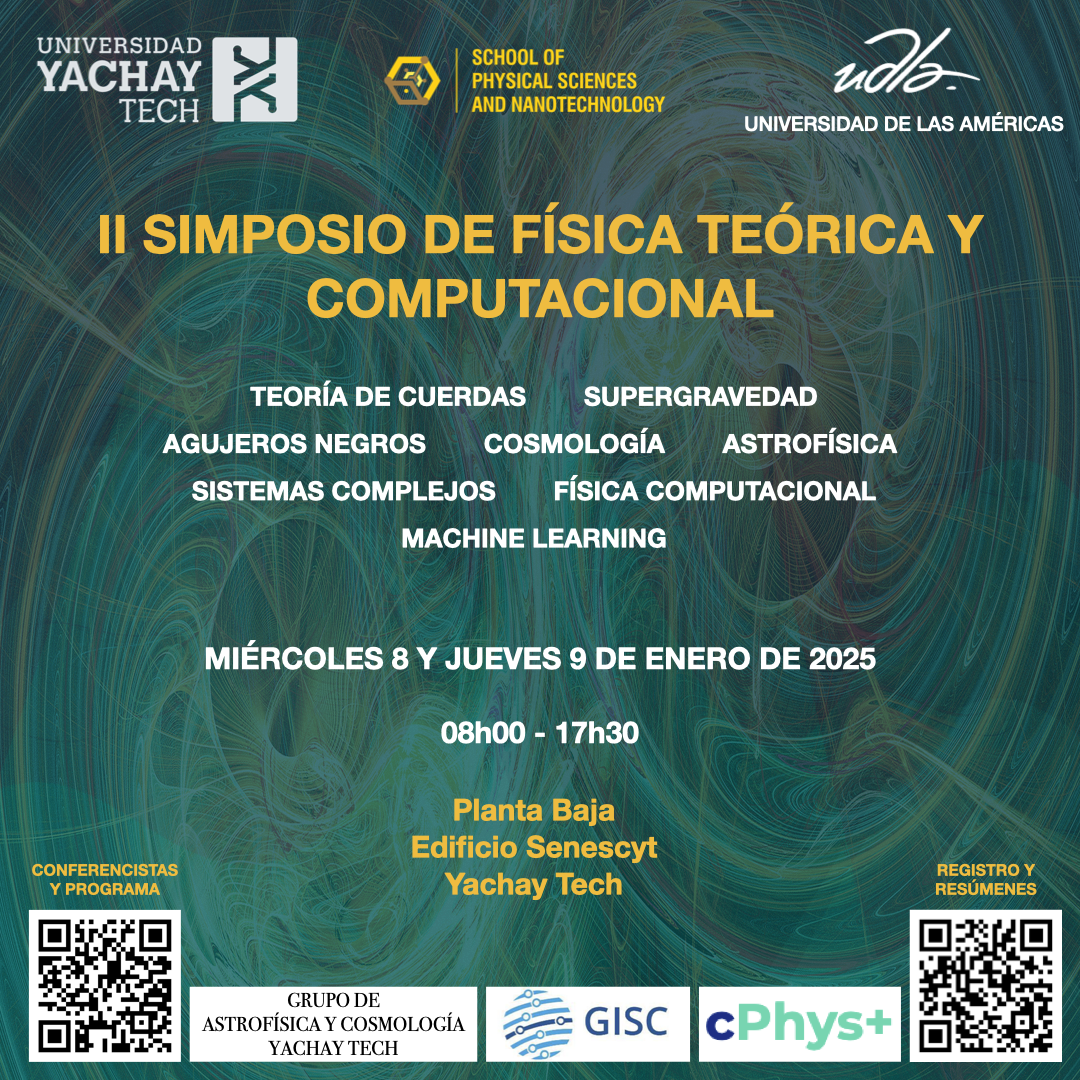
El II Simposio de Física Teórica y Computacional reúne a expert@s y estudiantes de pregrado y posgrado.
Tiene como objetivo el compartir avances y perspectivas en los campos teóricos y numéricos de la física.
La primera edición del simposio se realizó en enero de 2022 y tuvo un día de duración.
Este año hemos decidido realizarlo en 2 días (formato presencial) e incluir temas relacionados a:
Física Teórica, teoría de cuerdas y gravedad
Relatividad General, Astrofísica y Cosmología
Sistemas Complejos y Caos
Física Computacional y Machine Learning
Conferencistas
Pablo Bueno, Universidad de Barcelona (Física Teórica)
Jonathan Quirola, Radboud University (Astrofísica)
Clara Rojas, Universidad Yachay Tech (Cosmología)
Paúl Sánchez, Universidad de Colorado Boulder (Astrofísica)
Nicolás Vásquez, Escuela Politénica Nacional (Astrofísica)
Christian Vásconez, Escuela Politénica Nacional (Física teórica)
Mario Cosenza, Universidad Yachay Tech (Sistemas Complejos)
Andrés Morales Navarrete, Universidad de las Américas (Física Computacional)
Álvaro Dueñas, Escuela Politénica Nacional (Física teórica)
Julio Andrade, Escuela Superior Politécnica de Chimborazo (Física Teórica)
Boris Bermúdez, U. Católica de Chile (Física teórica)
Fernando García, U. San Francisco de Quito (Física teórica)
Helga Dénes, Universidad Yachay Tech (Astrofísica)
Óscar Lasso Andino, Universidad de las Américas (Física Teórica)
Wladimir Banda-Barragán, Universidad Yachay Tech (Física Computacional)
Programa
Miércoles 8 de enero de 2025
El 1er día del simposio se llevará a cabo en formato presencial en el siguiente horario:
| Hora | Actividad | Tema |
|---|---|---|
| 08:00 - 08:40 | Registro | -- |
| 08:40 - 09:00 | Bienvenida Día 1 | Breve introducción al simposio, temas del primer día, objetivos y rationale científico. |
| 09:00 - 09:40 | Charla 1 (Helga Dénes, YT) | Open problems in Astrophysics: from dark matter to possible extraterrestrial life |
| 09:40 - 10:20 | Charla 2 (Óscar Lasso, UDLA) | Massive particle surfaces and partial unbilicity |
| 10:20 - 11:00 | Charla 3 (Pablo Bueno, U. Barcelona) | Singularidades espacio-temporales |
| 11:00 - 11:20 | Refrigerio | -- |
| 11:20 - 12:00 | Charla 4 (Clara Rojas, YT) | Cosmología Inflacionaria |
| 12:00 - 12:40 | Charla 5 (Álvaro Dueñas, EPN) | A quantum-mechanical model for lightlike particles with gravity |
| 12:40 - 13:30 | Mini-charlas (5 mins) | Lizbeth Lara (The Physical Properties of Cold Gas at High Galactic Latitudes in the Milky Way), Mariannly Márquez (Inflationary Cosmology 101: Foundations and Open Problems), Daniel Arias (The nature of cold gas in the Chamaeleon molecular cloud complex), Carlos Jurado (Destello Físico y la importancia de la divulgación científica), Jhon Villacis (Self-control of supertransient collective chaos in coupled map networks), Juan Vizcaino (Agent-based model for optimisation of vehicular traffic flow), David Lara (Tailoring the Properties of Graphene and Carbon Quantum Dots: From Edge Geometry to Crystalline-Amorphous Transitions), Oswaldo Ramírez (Modelamiento de la interacción Argonauta2-miR33a-oligonúcleotido mediante herramientas de Química computacional), Jorge Eduador Cargua Merlo (Emmy Noether: Uniendo Mentes y Ciencia para el Progreso Académico y Social) |
| 13:30 - 15:00 | Almuerzo | -- |
| 15:00 - 15:40 | Charla 6 (Julio Andrade, ESPOCH) | Effect of gravitational cracking on energy exchange in stellar compact object: the isotropic case |
| 15:40 - 16:20 | Charla 7 (Jonathan Quirola, Radboud) | Una nueva era para los transitorios rápidos en Rayos X: primeras detecciones realizadas por Einstein Probe |
| 16:20 - 17:00 | Charla 8 (Nicolás Vásquez, EPN) | Algoritmos de Recomendación Basados en el Ambiente Estelar de Candidatas a Progenitoras de Estallidos de Rayos Gamma (GRBs) |
| 17:00 - 17:10 | Charla 9 (Fernando García, U. San Francisco de Quito) | Open and Closed Strings in Superstring theories II: The Strings Tensionless Limit |
| 17:10 - 17:20 | Charla 10 (Boris Bermúdez, U. Católica de Chile) | A geometric approach to the Exact Renormalization Group flow of non-Abelian gauge theories |
| 17:20 - 18:00 | Presentaciones de Pósters | Lizbeth Lara (The Physical Properties of Cold Gas at High Galactic Latitudes in the Milky Way), Mariannly Márquez (Inflationary Cosmology 101: Foundations and Open Problems), Daniel Arias (The nature of cold gas in the Chamaeleon molecular cloud complex), Carlos Jurado (Destello Físico y la importancia de la divulgación científica), Jhon Villacis (Self-control of supertransient collective chaos in coupled map networks), Juan Vizcaino (Agent-based model for optimisation of vehicular traffic flow), David Lara (Tailoring the Properties of Graphene and Carbon Quantum Dots: From Edge Geometry to Crystalline-Amorphous Transitions), Oswaldo Ramírez (Modelamiento de la interacción Argonauta2-miR33a-oligonúcleotido mediante herramientas de Química computacional), Jorge Eduador Cargua Merlo (Emmy Noether: Uniendo Mentes y Ciencia para el Progreso Académico y Social) |
Jueves 9 de enero de 2025
El 2do día del simposio se llevará a cabo en formato presencial en el siguiente horario:
| Hora | Actividad | Tema |
|---|---|---|
| 08:00 - 08:40 | Registro | -- |
| 08:40 - 09:00 | Bienvenida Día 2 | Breve introducción a los temas del segundo día, objetivos y rationale científico. |
| 09:00 - 09:40 | Charla 11 (Mario Cosenza, YT) | Estructura de comunidades en redes complejas |
| 09:40 - 10:20 | Charla 12 (Wladimir Banda-Barragán, YT) | Computational physics and complexity: the mysterious power laws in multiphase turbulent plasmas |
| 10:20 - 11:00 | Presentaciones de Pósters / Refrigerio | Lizbeth Lara (The Physical Properties of Cold Gas at High Galactic Latitudes in the Milky Way), Mariannly Márquez (Inflationary Cosmology 101: Foundations and Open Problems), Daniel Arias (The nature of cold gas in the Chamaeleon molecular cloud complex), Carlos Jurado (Destello Físico y la importancia de la divulgación científica), Jhon Villacis (Self-control of supertransient collective chaos in coupled map networks), Juan Vizcaino (Agent-based model for optimisation of vehicular traffic flow), David Lara (Tailoring the Properties of Graphene and Carbon Quantum Dots: From Edge Geometry to Crystalline-Amorphous Transitions), Oswaldo Ramírez (Modelamiento de la interacción Argonauta2-miR33a-oligonúcleotido mediante herramientas de Química computacional), Jorge Eduador Cargua Merlo (Emmy Noether: Uniendo Mentes y Ciencia para el Progreso Académico y Social) |
| 11:00 - 11:40 | Charla 13 (Andrés Morales Navarrete, UDLA) | Decoding biological systems using AI and computational physics |
| 11:40 - 12:20 | Charla 14 (Paul Sánchez, U. Colorado Boulder) | Asteroides Pequeños como Medios Granulares: Agregación, Estructura Interna y Disipación |
| 12:20 - 13:00 | Charla 15 (Christian Vásconez, EPN) | Transferencia de energía en plasmas espaciales turbulentos |
| 13:00 - 13:40 | Mini-Foro | Perspectivas Futuras de Investigación en Física Teórica y Computacional en Ecuador |
| 13:40 - 15:00 | Almuerzo | -- |
| 15:00 - 18:00 | Reuniones de Trabajo |
Resúmenes
Nicolás Vásquez (EPN), Algoritmos de Recomendación Basados en el Ambiente Estelar de Candidatas a Progenitoras de Estallidos de Rayos Gamma (GRBs).
La astronomía tiene un impacto profundo en diversos ámbitos, como la ciencia, la filosofía y las costumbres, además de proporcionar acceso abierto a datos observacionales. Este acceso libre desmitifica la idea de que la práctica profesional en astronomía requiere necesariamente grandes inversiones económicas. En la actualidad, el análisis de datos astronómicos se sustenta en herramientas avanzadas como la estadística y el aprendizaje automático, competencias que no solo son esenciales en este campo, sino también altamente valoradas en el ámbito empresarial. Esta investigación se centra en las poblaciones estelares cercanas a fuentes de radiación gamma, cuyo origen y emisión de alta energía influyen significativamente en su entorno. Para llevar a cabo este análisis, se utilizarán los catálogos de los observatorios espaciales Gaia y Fermi, enfocándose en cúmulos globulares y remanentes de supernovas como objetos de estudio. Cuando las estrellas abandonan la secuencia principal, entran en un régimen de emisión en altas energías, interactuando con las estrellas vecinas. Este fenómeno es de particular interés para la astronomía en multifrecuencia y representa una oportunidad para impulsar el estudio formal de la astronomía en el país. El estudio de la población estelar local permitirá evaluar la influencia de las fuentes gamma en su entorno, identificando variaciones en la distribución de estrellas según su tipo espectral. Los diagramas de Hertzsprung-Russell serán clave para estimar tanto la edad de las poblaciones estelares como su composición en función del tipo espectral. Un posible efecto de la presencia de estrellas emisoras de rayos gamma es la fotoevaporación, que podría alterar las características del medio interestelar circundante entre otros procesos astrofísicos.
Álvaro Dueñas (EPN), A quantum-mechanical model for lightlike particles with gravity.
Nowadays Einstein's General Relativity is our best attempt of a theory for gravity. However, it fails to be a field theory that can be quantized. The incompatibility between Quantum Field Theory and General Relativity can be traced until the local realism problem. So, previously to look for a quantum theory of gravity, we must build models in order to describe the physics for particles responding to quantum mechanics in a (classical) pseudo-Riemannian geometry. Here we present a model for quantum states of null geodesics in Brinkmann spaces and show that no local effects, space-time tunneling and entanglement, appear in presence of gravity. Finally, the presence of gravity in the harmonic gauge can be traced to a two dimensional action functional for the transverse degrees of freedom that recovers the bosonic string action with a no-trivial and no-linear potential which brokes the conformal symmetry of the word-sheet.
Boris Bermúdez (U. Cat. Chile), A geometric approach to the Exact Renormalization Group flow of non-Abelian gauge theories.
In recent decades, the growing power of machine learning has had a significant impact on mathematical physics. In this talk, I present the fundamental concepts underlying the development of a geometric framework that facilitates the study of non-perturbative Quantum Chromodynamics (QCD) through the lens of Optimal Transport Theory. This approach naturally incorporates neural networks as tools for solving the QCD equations. A brief historical overview of Quantum Chromodynamics (QCD) is presented, tracing its development from the discovery of asymptotic freedom to modern renormalization techniques employed in the study of QCD's non-perturbative regime. I also provide a concise description of the geometry of the field configuration space in pure Yang-Mills theories and highlight some recent advancements in this area.
Lizbeth Lara (YT), The Physical Properties of Cold Gas at High Galactic Latitudes in the Milky Way.
One of the most important components of the interstellar medium in our Galaxy is the neutral atomic hydrogen (HI). HI is predominantly found in the disk of the Galaxy. However, various processes, such as galactic winds, can expel a significant fraction of the HI above the Galactic plane into the halo of the Milky Way. This project aims to investigate the HI's cold component above the Galactic plane by combining HI emission and absorption measurements from large sky surveys. The recent development of new receiver technology made new all sky surveys possible in the radio domain. The Wallaby survey on the ASKAP telescope currently observes the southern sky in the 21 cm HI spectral line. This project will use HI absorption measurements from the Wallaby survey and HI emission data from the archival GASS survey. The data is used to calculate the physical properties of the neutral atomic hydrogen, such as the optical depth, column density, cold gas fraction. Finally, the project analyzes if there are any spatial trends in the properties of the cold gas.
Mariannly Márquez (YT), Inflationary Cosmology 101: Foundations and Open Problems.
Understanding the universe as a whole depends on how its smallest building blocks interact. Inflationary cosmology is a powerful framework that combines ideas from particle physics and gravitation to explain the universe's early stages. This talk provides a concise overview of the foundations of this theory and the open questions it leaves behind. We begin with the Hot Big Bang model, following the universe's evolution through its major events. We then explore inflation, the widely accepted explanation for the early universe, which solves key challenges of the Big Bang model, such as the flatness, horizon, and monopole problems, and explains the origin of the density fluctuations observed in the Cosmic Microwave Background (CMB). Despite its success, the standard model of cosmology, including inflation, raises unresolved questions, such as naturalness problems and tensions with the standard model of particle physics ΛCDM. We will also mention alternatives to inflation that aim to address these challenges.
Daniel Arias (YT), The nature of cold gas in the Chamaeleon molecular cloud complex.
The Milky Way harbors more gas than the detected by current methods. Gamma-ray observations reveal a significant discrepancy, suggesting the presence of a "dark neutral medium" (DNM). This project aims to determine the fraction of this DNM in the Chamaeleon region that is cold HI, by analyzing HI emission and absorption data.
Juan Diego Vizcaino Soriano (YT), Agent-based model for Optimization of Vehicular Traffic Flow.
Proponemos un modelo basado en agentes para estudiar el tráfico vehicular en áreas urbanas, centrándonos en el impacto de los ciclos de los semáforos en el tiempo de viaje promedio de los vehículos. El modelo se implementa en un código eficiente en Python. Encontramos que las configuraciones de los semáforos influyen significativamente en los tiempos de viaje. Al considerar las interacciones entre semáforos, mostramos que se puede lograr una configuración óptima que minimiza el tiempo de viaje promedio para la mayoría de los ciudadanos. Nuestros resultados indican que, aunque algunas configuraciones benefician a la mayoría, pueden afectar negativamente a una minoría, especialmente en viajes cortos. También demostramos que es posible mantener un tiempo de viaje promedio relativamente constante para varios agentes, lo cual es crucial para optimizar el flujo de tráfico sin afectar gravemente a ningún grupo específico. Como aplicación, consideramos las configuraciones de calles y semáforos en Quito, Ecuador, aunque nuestro modelo puede aplicarse a otras ciudades del mundo.
Oswaldo Julio Ramírez Delgado (ESPE), Modelamiento de la interacción Argonauta2-miR33a-oligonúcleotido mediante herramientas de Química computacional.
Atherosclerosis is an inflammatory disease that begins with damage or inflammation in the inner lining of the arteries, where the gradual accumulation of plaque on the arterial walls is crucial. This plaque is composed of a mixture of substances including fats, cholesterol, cellular waste, calcium, and fibrin. Over time, this plaque accumulation can increase and harden the arteries, thereby reducing blood flow and oxygen supply to organs and tissues. This decreased blood flow can lead to a range of serious complications such as cardiovascular disease (CVD), including heart attacks, strokes, or peripheral circulatory problems. It is the cause of 33% of global deaths. Therefore, our research took on the challenge of designing a nucleic acid-based therapy to promote reverse cholesterol transport. In this regard, an AGO2-miR33a ribonucleoprotein complex, responsible for silencing key genes in cholesterol metabolism and reverse transport, was modeled using deep learning and molecular dynamics (MD) tools. Four antisense DNA molecules were designed based on minimum free energy (MFE) and template, aimed at inhibiting the ribonucleoprotein. MD results of the ribonucleoprotein indicate conformational changes that make the initial model resemble other experimental AGO2-miRNA complexes. MD of the DNAs shows that structures capable of inhibiting AGO2-miR33a have been obtained. Concluding that the candidate DNA structures could be a possible therapy for the early treatment of atherosclerosis.
Carlos Enrique Jurado Méndez (ESPOCH), Destello Físico y la importancia de la divulgación científica.
Se presentará la importancia de la divulgación científica (especialmente la física) al público general y como Destello Físico apoya en esta tarea y alienta a estudiantes de Bachillerato a seguir estar carrera.
Jhon Villacís (YT), Self-control of supertransient collective chaos in coupled map networks.
Supertransient collective chaos is an emergent phenomenon that consists of the appearance of a chaotic time window (before reaching a stable state) when periodic maps are coupled together, with the particularity that the length of this chaotic window depends exponentially on the number of coupled elements. Thus, being a very curious and unexpected phenomenon in which chaos arises from stable periodic elements. In this work, we study how various coupling parameters, specially the network topology, affect the length of the chaotic window allowing us to propose a mechanism for autonomous control of this phenomenon. Our method can be extended to networks of coupled time-continuous periodic dynamical systems.
David Lara (YT), Tailoring the Properties of Graphene and Carbon Quantum Dots: From Edge Geometry to Crystalline-Amorphous Transitions.
Graphene Quantum Dots (GQDs) and Carbon Quantum Dots (CQDs) are nanoscale carbon materials with unique electronic, optical, and chemical properties, enabling applications in optoelectronics, bioimaging, sensing, and energy conversion. These properties depend on structural factors like edge geometry, size, and crystallinity. Using Density Functional Theory (DFT), we analyze the electronic, vibrational, and optical properties of large GQD and CQD structures. This study reveals key patterns linking structural features to material behavior, offering insights for designing carbon-based nanomaterials with tailored properties.
Jorge Eduador Cargua Merlo (ESPOCH), Emmy Noether: Uniendo Mentes y Ciencia para el Progreso Académico y Social
Esta charla tratará sobre el Club de Física Emmy Noether, una organización estudiantil dedicada a la divulgación e investigación científica. Presentaremos nuestra misión de promover el desarrollo académico y científico mediante actividades como Café Científico, charlas, la revista Quantum Freak, exposiciones y cursos. También hablaremos sobre nuestra visión de ser un referente nacional en la investigación y divulgación científica, fomentando la colaboración entre estudiantes y docentes, y contribuyendo al crecimiento personal y social de nuestros miembros.
Participantes
|
Stephanie Nicole Enríquez Olivo |
|
Ricardo Paúl Calderón Álvarez |
|
Andy Sebastián Vinueza Ruiz |
|
Emilio José Clavón Quilachamin |
|
Lizbeth Alexandra Lara Perugachi |
|
Nadhine Cristina Custode Silva |
|
Joseph Alexander Granja Vélez |
|
Emilio Pantoja Rosero |
|
Bryan Roberto Tipan Garzon |
|
William Alexander Carvajal Morales |
|
Gary Leonel Guaman Toasa |
|
Luis Felipe Gualco Centeno |
|
Rolando Sebastián Sánchez García |
|
ORLANDO VINICIO GUTIERREZ PROAÑO |
|
Doménica Solange Quizhpe Romero |
|
Jorge Fabricio Gallegos Maldonado |
|
Eduardo Emmanuel Lasluisa Paz |
|
Franklin Ronaldo Limaico Ibadango |
|
Daniel Sebastián Arias Toctaguano |
|
Vincent Nicolas Noguera Sangurima |
|
Juan Diego Vizcaino Soriano |
|
Pedro Francisco Zamora Dávila |
|
Keyla Dayanara Campos Paredes |
|
Paul Gerardo Bastidas Yautibug |
|
Dalis Jasu Corrales Chuquitarco |
|
Roberto Carlos Guadalupe Copa |
|
Anthony Alexander Chanatasig Villalta |
|
Gabriela Siomara Flores Chávez |
|
Diego Dario Niza Lagla |
|
Mauricio André Jara Guevara |
|
Melany Danae Carvajal Ahtty |
|
Henry Joel Ninabanda Pilco |
|
Christian Agustín Andrade Carranza |
|
Luis Jeampier Calle Samaniego |
|
Jonnathan Marcelo Vazquez Pacurucu |
|
Alexander Ramiro Sarango Torres |
|
Yomaira Elizabeth López Revelo |
|
Angie Carolina Dávila Porras |
|
Oswaldo Julio Ramírez Delgado |
|
Carlos Enrique Jurado Méndez |
|
Nadia Briggite López Piguave |
|
Marco Alexander Panchi Herrera |
|
César Alexander Matailo Matailo |
|
Kevin Pachacama |
|
Yudith Lisbeth Toapanta Arequipa |
|
Dayana Michelle Chaglla Supe |
|
Mariannly Estefany Marquez Urdaneta |
|
Hernán Alfonso Espinoza Burbano |
|
Mayelin Paola Placencia Delgado |
|
Jhon Steeven Villacís Ramón |
|
Alan Israel Palma Travez |
|
Sebastián Stalin Chicaiza Medina |
|
David Lara |
|
Abigail Fernanda Rivadeneira Pallazhco |
|
Elizabeth Chafla |
|
Angel David Rodriguez Ocaña |
|
Ivan P. |
|
Esteban Orozco |
|
Daniel Eliecer Mayorga Hermoza |
|
Jorge Eduador Cargua Merlo |
|
Cinthya Lisbeth Campues López |
Registro (cerrado)
Si deseas contribuir con un póster acompañado de una mini-charla, ingresa el título y resumen de tu contribución a través del formulario.
Todas las contribuciones de estudiantes de pregrado tendrán un espacio para una mini-charla (5 mins) y un espacio para un póster.
Todas las contribuciones de estudiantes de posgrado tendrán un espacio para una mini-charla (10 mins) y un espacio para un póster.
La idea es que la mini-charla sea una invitación a mirar el póster de la investigación realizada.
Los pósters deben presentarse en formato A0, de preferencia impresos en sentido vertical ("portrait").
Para registrarte, da clic en la imagen QR o visita este enlace: https://forms.gle/YAfRn4LFHN6zQmfK7.







Póster del Evento